
What is a work permit and who needs one?
A work permit is an official document issued by the Ministry of Labour and Social Security that gives a foreigner the right to both work and reside in Türkiye for as long as it is valid. Every foreigner covered by Law No. 6735 must hold either a work permit or a work permit exemption before starting work.
The most common misunderstanding: a residence permit is not a work right
Except for refugees and holders of subsidiary protection, a residence permit obtained for any reason gives no right to work. Student residence, family residence, short-term residence — none of them substitutes for a work permit. The reverse does hold: once you have a work permit, that document also counts as a residence permit.
Permits issued to people under temporary protection, international protection applicants and conditional refugees are the exception — for them the document does not replace a residence permit.
The penalty for working without a permit
Administrative fines are imposed on both the foreigner found working without a permit and the employer. The foreigner is also reported to the Ministry of Interior for deportation. The risk is not one-sided, which is why serious employers will not let anyone start before seeing the permit.
Who can work without a permit
- Blue Card holders — those who were Turkish citizens by birth, left citizenship with permission, and their descendants to the third degree
- Foreigners with refugee or subsidiary protection status
- Members of diplomatic missions
- Groups exempted under bilateral or multilateral agreements Türkiye is party to
Which permit type fits you?
Choosing the right type is half the file. An application opened under the wrong type is refused even when every document is in order. The Ministry issues cards for five different work permit types.
Fixed-term (dependent) work permit
The most common type. Granted for one specific employer and workplace, not exceeding the term of the employment or service contract. The first application grants up to one year. With the same employer, the first extension runs up to two years and later ones up to three.
Indefinite work permit
Open to foreigners holding a long-term residence permit or at least eight years of legal work permits. It is not tied to an employer, and the holder enjoys every right a long-term residence permit provides. Meeting the conditions does not create an absolute entitlement. The document is valid for five years and must be renewed within the six months before expiry, and in any case before the date passes.
Independent work permit
Gives a foreigner the right to work on their own account, with no employer, for a fixed term. Assessment weighs education, professional experience, contribution to science and technology, the effect of the activity or investment on the economy and employment, and share capital where the person is a company partner.
Temporary and international protection work permits
Separate regulations and different document sets apply. The permit issued does not replace a residence permit, and this is stated plainly on the back of the card — in Turkish and Arabic for temporary protection, in Turkish and English for international protection. If the Ministry of Interior ends the residence right, the work permit becomes invalid too. Where a permit is granted outside the province of registration, a travel permit document is needed.
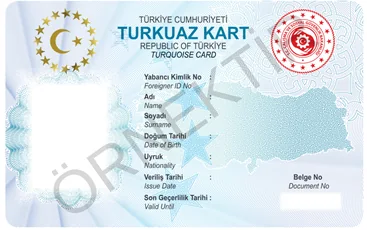
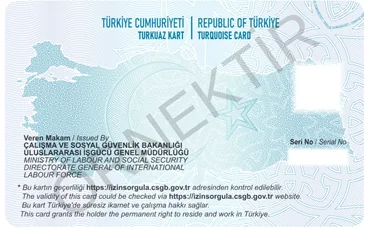
Turquoise Card
For qualified professionals, investors and academics. The first three years are a transition period, during which the Ministry may request information and documents from the employer or the foreigner. If it is not cancelled during that period, the transition note is removed on the foreigner's application and an indefinite Turquoise Card is issued. The holder enjoys the rights an indefinite work permit provides. Spouses and dependent children receive a Turquoise Card Holder's Relative Card, which does serve in place of a residence permit.
Domestic work — elderly, disabled or child care and patient companionship — has no separate permit type; a fixed-term permit is issued. But the five-Turkish-citizen employment criterion does not apply to these files, and the employer is the person needing care or a first-degree relative.
Applying from inside Türkiye: step by step
For foreigners in Türkiye holding a residence permit issued for at least six months and still valid on the application date, the employer applies directly to the Ministry. Certain groups designated by the Directorate General may also apply through the system without a residence permit, provided they are legally present.
- Sign the employment contractThe application only starts with a signed employment or service contract. The salary and working hours in it must match exactly what is declared in the application.
- Open the workplace recordThe workplace's SGK e-Bildirge user logs in via e-Devlet at calismaizni.gov.tr and creates the workplace record. That person must hold an electronic signature in their own name.
- Authorise othersOnce the record is open, others can be given the right to apply on the workplace's behalf through Authorisation Procedures in the Employer Management Panel, by entering their Turkish ID number. There is no limit to how many people you authorise.
- Prepare and upload documentsEach document must be PDF and no larger than 2 MB. Every foreign-language document needs a sworn translation with notary certification. Photographs must be JPEG, PNG, GIF or JPG; taken within the last six months, colour, front-facing, face uncovered and on a white background — biometric standard.
- Select the job titleType at least three letters of the job title and every matching entry is listed. Choose the one consistent with the employment contract.
- Complete with an electronic signatureCheck that every tab carries a green tick. An application counts as complete only once it is e-signed; unsigned ones sit in the Incomplete Applications section and are never assessed.
The e-İzin system runs most smoothly in Google Chrome. If the e-signature window does not open when you press Save, allow pop-ups in your browser settings.
Applying from abroad: step by step
This is the route if you have no valid residence permit in Türkiye or are currently outside the country. It runs in two stages, and the deadline between them matters.
- Apply at the consulateThe foreigner goes in person to a Turkish embassy or consulate general in their country of citizenship or lawful residence and files the work permit application. A 16-digit reference number is issued on the basis of that application.
- Pass the reference number to the employerThe foreigner gives the reference number to their employer in Türkiye.
- The employer files in the systemUsing that reference number, the employer completes the application via e-Devlet at calismaizni.gov.tr. This step must happen within ten working days.
- Pay the feesIf the permit is granted, the foreigner returns to the mission where they applied and pays the work permit, residence permit and visa fees. The application is refused if the fee and valuable paper charge are not paid within thirty days of notification.
- Visa and entryOnce the mission places the visa sticker in the passport, the foreigner may enter Türkiye. Registration with the address system is required within twenty days of entry.
Which documents are required?
The final list depends on permit type, sector, nationality and profession. The items below appear in almost every file. The Ministry's current list is at csgb.gov.tr/uigm/belgeler.
From the foreign employee
- Passport copy — with a notarised sworn translation if not in Latin script
- Valid residence permit (for in-country applications, at least six months)
- Diploma or provisional graduation certificate
- YÖK equivalence certificate — for regulated professions and graduates of foreign institutions
- Biometric photograph
- Signed employment or service contract
From the employer
- SGK e-Bildirge user details and electronic signature
- Trade Registry Gazette of incorporation
- Balance sheet and profit/loss statement for the latest year
- Tax certificate
- Signature circular
- Application letter and undertaking
Added in special cases
- Domestic work: proof of relationship and the cared-for person's ID copy
- Foreign doctors and nurses: preliminary approval from the Ministry of Health
- Regulated professions: an opinion from the relevant chamber or ministry
Most refused files fail not on a missing document but on an uncertified translation. Every foreign-language document needs a sworn translation with notary certification; an uncertified translation is on its own a ground for refusal.
How is your application assessed?
Applications are reviewed against the Ministry's assessment criteria and international labour force policy. The state of the labour market and sectoral and economic conditions are taken into account. Where needed, opinions are sought from relevant public bodies and professional chambers.
The employment ratio: the five-citizen rule
As a general rule, at least five Turkish citizens must be insured at the workplace for each foreigner to be employed. This is where files most often fail. Exceptions exist: for businesses meeting the criteria for foreign direct investments of special significance, the requirement is not sought for the first foreigner in a key personnel role. It is not sought in domestic work either.
Salary level
The salary must suit the nature of the work and reach a set multiple of the minimum wage. The required ratio varies by occupational group and is higher for senior management and engineering roles. The declared salary must be consistent with the employment contract and the social security declaration.
The company's financial position
At least one of paid-in capital, gross sales or export figures is expected to meet the set thresholds. Newly established workplaces are assessed separately.
Profession restrictions
No work permit can be issued for professions and posts reserved by law for Turkish citizens. The best known are law, notary services, judgeship and prosecution, pharmacy, dentistry, veterinary medicine, nursing aide work, certified accountancy, tourist guiding, private security, customs brokerage assistance and mediation. The list is longer; the profession must be checked before a file is opened.
Passport validity
A work permit is issued sixty days shorter than the validity of the passport or equivalent document. If your passport is close to expiry, so is your permit — renewing it before applying is usually the sensible move.
Fees and the valuable paper charge
Under Fees Law No. 492, work permits and exemptions issued to foreigners carry a fee. Under Valuable Papers Law No. 210, a valuable paper charge is also collected for each document issued. Current amounts change annually; check csgb.gov.tr/uigm.
How to pay
Through the Digital Tax Office, on the Payment by Reference Number screen: select the Directorate General of International Labour Force as the institution and enter the foreigner ID number beginning with nine and the transaction number emailed to you. Payment through contracted banks is also possible; in that case the permit fee and the valuable paper charge go to the notified account codes on separate receipts.
If the amount paid is short or excessive the process cannot be completed. Payment must match to the kuruş. No transfer charge is paid to banks, and no receipt needs to be submitted to the Ministry — payments are visible in the system.
Exemptions
No fee is collected for exemption applications requested for less than three months. Turquoise Card holders pay no fee, only the valuable paper charge for the document issued.
The decision, the document and what follows
With complete information and documents, an application is decided within thirty days. The clock starts when the application is completed in the system, or when requested additional documents are uploaded. The decision, whether positive or negative, goes to the email address given in the application and can be seen in the e-İzin system.
How the document arrives
Once printed, approved work permit documents are sent by PTT courier to the employer's address. Delivery can be followed through notifications to the registered mobile number or the Card Tracking tab in e-İzin. If the document is lost or damaged beyond use, a reprint is requested through New Card Request; if approved, the valuable paper charge plus half the permit fee is requested.
Deadlines you cannot miss
- Starting work — within one month of the permit's start for in-country applications; within one month of entry and in any case within six months of the permit's start for applications from abroad
- Address registration — within twenty days of entering on a work visa
- Notification duty — the start and end of employment and anything that would void the permit must be reported to the Ministry within fifteen days
- Extension — from sixty days before expiry and in any case before the permit runs out
- Appeal — within thirty days of notification of a refusal, cancellation or termination
Changing workplace
A permit is issued for a specific job, workplace and address. A foreigner holding a permit with one employer cannot work for another on the same permit; a new employer means a new application. Moving to a different role with the same employer, or to another branch in the same line of business, depends on meeting the conditions.
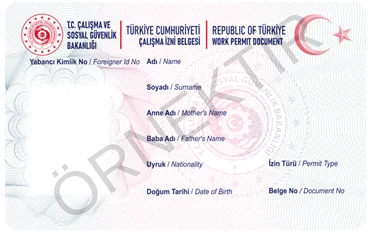
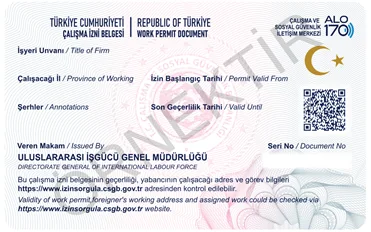
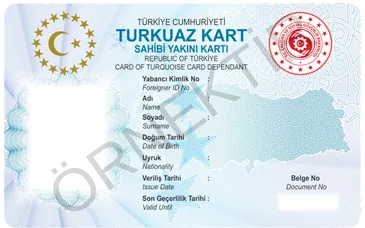
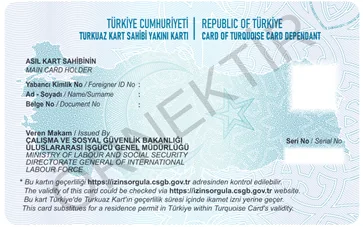
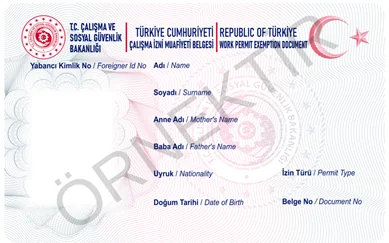
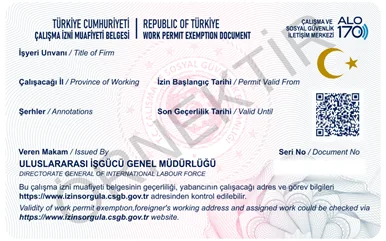
Work permit document — specimen image published by the Ministry. The front carries name, nationality, permit type and document number; the back carries the workplace title, the province of work, the permit's start and end dates and any annotations.
Extending the permit
An extension is filed through the system from sixty days before the permit expires, and in any case before the date passes. Once it has passed, no extension is possible and a fresh application is needed.
A foreigner whose extension has been filed may keep working after the permit expires while the application is assessed. That is subject to a limit of ninety days and to the job and the workplace staying the same. Work during this period counts as legal employment, and the rights and obligations of both foreigner and employer continue unchanged.
If the extension succeeds, the permit is issued for up to two years on the first extension with the same employer and up to three years on later ones.
What to do if the application is refused
A refusal, cancellation or termination decision is served on the employer or the foreigner. An appeal can be filed through the system within thirty days of notification, with a reasoned petition and supporting documents uploaded to e-İzin. If the Ministry rejects the appeal, administrative court remains open.
Separately from any appeal, a fresh application can be made once the deficiency behind the refusal has been fixed. A refusal does not bar a new application.
The seven most common mistakes
- Uncertified translation — uploading a foreign-language document without a sworn translation and notary certification. On its own a ground for refusal.
- Inconsistent declarations — the salary in the employment contract differing from the one declared in the system.
- A short passport — since the permit is issued sixty days shorter than the passport, a passport near expiry shortens the permit too.
- A closed profession — applying in a profession reserved for Turkish citizens. This should have been checked before the file was opened.
- No electronic signature — failing to complete the application with an e-signature. It may look saved in the system, but it is never assessed.
- Missing the deadline — trying to file an extension after the permit has expired. That time does not come back.
- Not checking the employment ratio — opening a file without verifying how many Turkish citizens are insured at the workplace.
Let's build your file together
The pre-assessment is free. Tell us your situation and we'll work out which route fits.
This guide is based on International Labour Force Law No. 6735, its implementing regulation and the Ministry's published application guides. It is general information, not legal advice, and the legislation can change. For official and current details see calismaizni.gov.tr, csgb.gov.tr/uigm or call ALO 170.