
Which kinds of care work qualify?
A permit for domestic work covers care and companionship provided in the home. The Ministry treats these as fixed-term work permits rather than a separate category, but the assessment criteria differ noticeably from other sectors.
- Elderly care — daily care for older people who cannot manage on their own
- Patient companionship — accompanying and caring for patients who need constant support
- Disability care — care for disabled people who need assistance
- Child care — looking after and supervising children at home
Permits for cleaning, cooking or driving are assessed differently and do not benefit from the easements granted to care work. Choosing the right job description in the application is therefore critical.
The five-citizen rule does not apply
The employment ratio is where Turkish work permit applications most often fail: as a general rule, at least five Turkish citizens must be insured at the workplace for each foreigner employed. A family can never meet that.
For domestic care work the criterion is not sought. The employer here is not a business but the person needing care or their relative, so no ratio is calculated. This makes carer files markedly easier than files in other sectors.
Not applying the criterion does not mean the permit is guaranteed. The need for care must still be documented, and the foreigner's legal status and the declared salary are still assessed.
Who is the employer?
In domestic care work the employer is a private individual, not a company. Two situations arise.
The person needing care
If they are able to apply themselves, they are the employer directly. The workplace record opens with their identity details and electronic signature.
A first-degree relative
If the person needing care is elderly, disabled or otherwise unable to apply, a first-degree relative may act as employer. Parents, children and spouses count as first-degree. The workplace record then opens with that relative's details and electronic signature.
Whoever acts as employer must hold an electronic signature in their own name, obtained from a qualified certification provider before the application starts. This is the step most families overlook and the one that delays the process most.
Which documents are required?
In addition to the standard work permit documents, papers proving the care relationship are requested.
From the employer (the family)
- Electronic signature of the person acting as employer
- ID copy of the person receiving care
- Proof of relationship — a detailed civil registry extract where the employer is a relative
- Medical report showing the need for care (based on age, disability or illness)
- Application letter and undertaking
From the foreign carer
- Passport copy — with a notarised sworn translation if not in Latin script
- Valid residence permit (at least six months for in-country applications)
- Biometric photograph
- Signed employment contract
- Any training certificate in care or nursing, if held
Every foreign-language document needs a sworn translation with notary certification. An uncertified translation is on its own a ground for refusal, and it is why most rejected carer files come back.
Work address and provincial limits
The home where care will be provided is entered as the work address, and the permit is issued for that address and that province.
This matters if the household moves. A move to another address within the same province must be notified to the Ministry; a move to a different province means the situation has to be reassessed.
If the carer wants to leave and work for another family, the same permit does not cover it. A new employer means a new application.
Salary and social security
The declared salary must suit the nature of the work and must not fall below the minimum wage. The level expected in domestic care work is far lower than for senior management or engineering roles; minimum wage level is generally accepted.
Once the permit is granted, the employer must register the foreigner with social security and pay the contributions. There is a separate registration procedure for domestic workers; all branches of insurance apply for those working ten days or more per month.
The salary declared in the application and the one reported to social security must match. A discrepancy can lead to cancellation of the permit and administrative fines.
Duration and extension
The first application grants a permit for up to one year. With the same employer, the first extension runs up to two years and later ones up to three.
- Decision — thirty days when the file is complete
- Starting work — within one month of the permit's start for in-country applications
- Address registration — within twenty days of entering on a work visa
- Extension — from sixty days before expiry and before the date passes
- Appeal — within thirty days of notification of a refusal
A carer whose extension has been filed may keep working after the permit expires until the decision comes, for no more than ninety days and only if the job, the employer and the address stay the same.
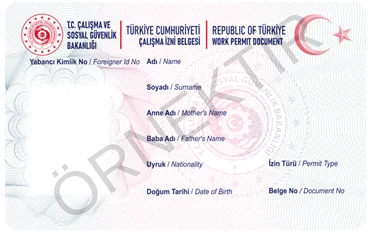
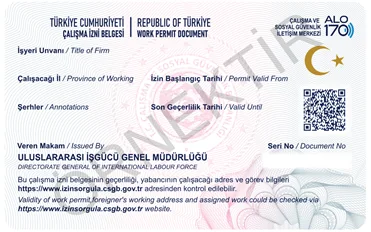
A domestic care permit is issued on the same document — specimen image published by the Ministry. The back shows the employer's name in place of a company title, the province of work and the permit period.
The most common mistakes in carer files
- No electronic signature — if the family member acting as employer has none, the application cannot even begin. This is the single biggest source of delay.
- Wrong job description — selecting cleaning or housework instead of care puts the file under different criteria.
- Missing proof of relationship — where the employer is a relative, the family tie must be documented.
- A medical report that does not show the need for care — a general report may not be enough; the need for assistance has to be evident.
- Uncertified translation — uploading the passport or other foreign documents without a notarised sworn translation.
- A short residence permit — in-country applications need a valid permit issued for at least six months.
- Starting work before the permit — this brings administrative fines for both the family and the carer, and the foreigner is reported for deportation.
Let's build your carer permit file
The pre-assessment is free. Tell us your situation and we'll see together whether it fits.
This guide is based on International Labour Force Law No. 6735 and its regulations. It is general information, not legal advice, and the legislation can change. For official details see calismaizni.gov.tr, csgb.gov.tr/uigm or call ALO 170.